

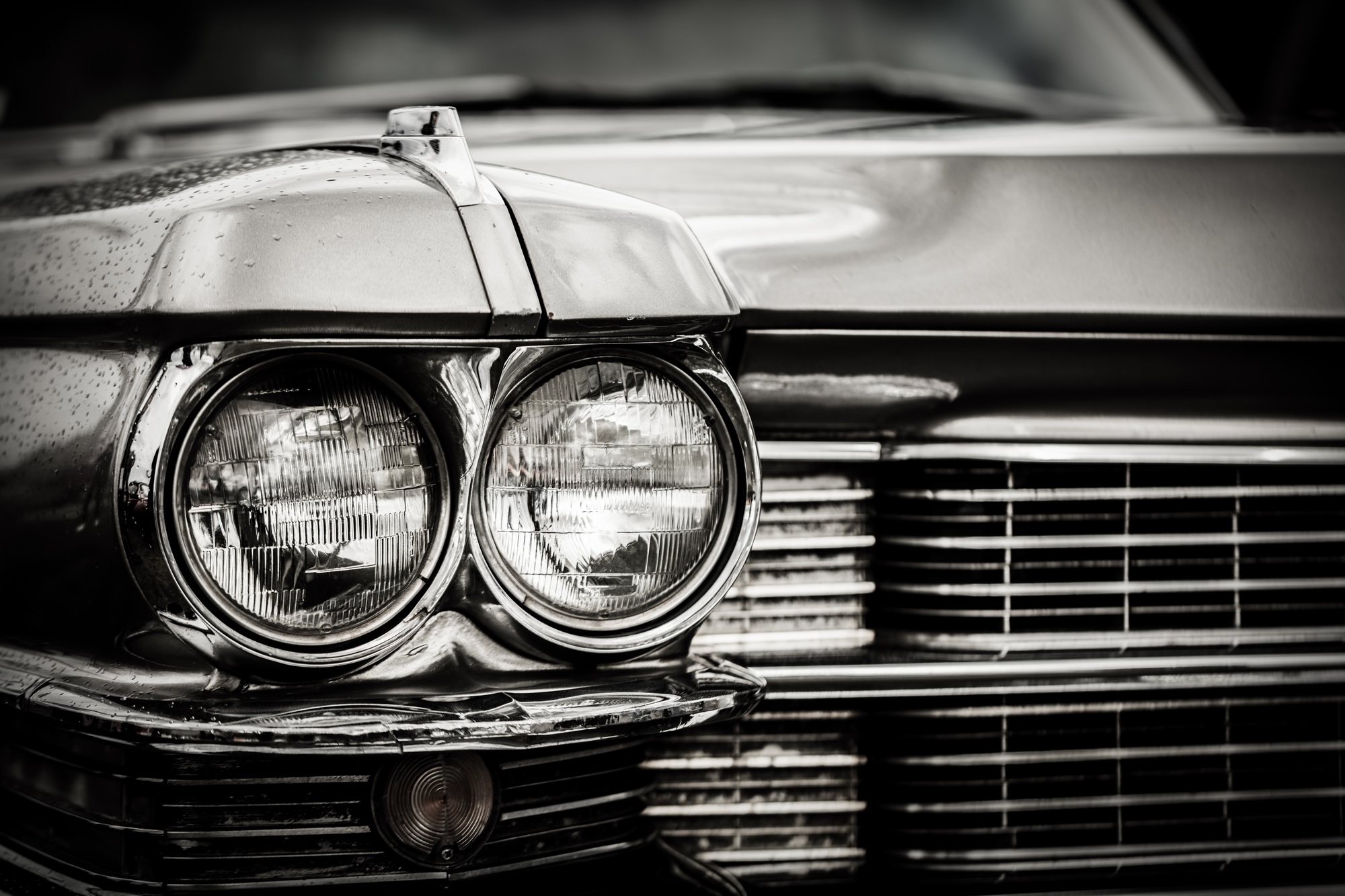
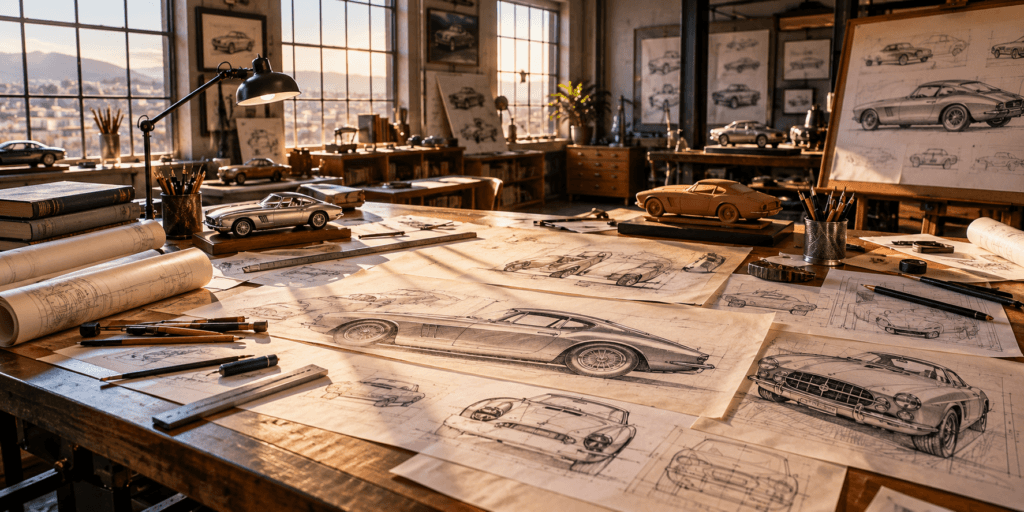
Before an automobile becomes a finished vehicle, it usually begins as an idea. That idea may appear as a quick pencil line, a collection of proportions, a side-profile study, or a detailed technical drawing. Long before metal, glass, leather, and paint come together, designers use drawings to explore what a vehicle could become.
Automotive design sketches provide a fascinating look at the creative process behind automobiles. They show how designers experiment with proportions, surfaces, windows, wheels, grilles, headlights, and other elements before a final design is selected. Today, these drawings are increasingly appreciated not only as working documents but also as examples of industrial design and automotive art.
The growing interest in design sketches is reflected by museums and exhibitions. In 2026, the National Motor Museum at Beaulieu announced an exhibition featuring contemporary artworks created from historic motoring blueprints, demonstrating how technical automotive drawings can be reinterpreted as modern art. Explore the National Motor Museum’s blueprint-inspired exhibition.
The First Lines of an Automobile
 An automotive design sketch can begin with remarkably little. A designer might start with a simple line representing the roof, another describing the hood, and a few marks establishing the wheels. From those basic elements, an entire vehicle can gradually emerge.
The early stage of design is about exploration. Designers may create dozens or even hundreds of variations before a particular direction becomes clear. Some sketches may focus on the overall silhouette, while others concentrate on individual details such as headlights, grilles, fenders, or windows.
This makes automotive sketches different from ordinary illustrations. They are often visual experiments. A drawing does not necessarily need to represent a finished vehicle. Instead, it can communicate an idea that might later be refined, changed, or discarded.
Why Early Sketches Are So Expressive
Early automotive sketches often have an energy that polished computer renderings do not. Quick lines can communicate movement and proportion without being restricted by excessive detail.
A designer can make a vehicle appear longer, lower, wider, or more aggressive simply by changing a few lines. The process allows ideas to develop rapidly before considerable time is invested in more advanced modeling.
For automotive artists, these early sketches are particularly interesting because they reveal the thinking behind the finished automobile. Instead of only seeing the final product, viewers can see the stages of visual experimentation that helped create it.
Automotive Design Sketches Are Historical Documents
Design drawings can also provide valuable evidence about automotive history. They show what designers were considering at particular moments and can reveal ideas that never reached production.
The Smithsonian’s Cooper Hewitt collection contains numerous automobile design drawings. One example is a 1940 DeSoto hood concept created using graphite and colored pencil. The drawing demonstrates how designers could combine technical information with artistic presentation while exploring the appearance of a vehicle. View the DeSoto hood concept at the Smithsonian.
Another Smithsonian example, a design for a compact car from the 1960s, shows how designers used markers, brushwork, and color to explore vehicle forms. Explore the Smithsonian’s compact-car design drawing.
These drawings demonstrate that automotive design has long existed at the intersection of engineering and visual creativity.
Ideas That Never Became Production Cars
One of the most fascinating aspects of automotive design archives is discovering concepts that never became production vehicles. Designers can explore unusual proportions, experimental body shapes, or unconventional features without knowing whether an idea will eventually be manufactured.
Some concepts remain drawings. Others become clay models or prototypes. A small number eventually influence production vehicles.
For enthusiasts, these abandoned ideas can be just as interesting as famous production cars because they reveal alternative paths that automotive design could have taken.
From Pencil Sketch to Three-Dimensional Form
Once a promising design direction is selected, designers can develop the idea further. Drawings may become more detailed, with additional views showing the vehicle from the front, side, rear, and three-quarter perspective.
Designers may also create full-size drawings and physical models to study proportions. The Museum of Modern Art’s collection includes General Motors design tools and documentation showing how automobile design involved detailed drawings and physical templates. Explore MoMA’s historic General Motors design template.
Physical modeling allows designers to understand how lines and surfaces interact in three dimensions. A shape that looks attractive from one angle may not work from another. The transition from sketch to physical form therefore becomes an important stage of automotive design.
The Role of Proportion
Proportion is one of the foundations of automotive design. The relationship between the wheels, cabin, hood, windshield, roof, and body determines much of a vehicle’s visual character.
Even small changes can create a dramatically different appearance. Moving the wheels slightly forward can change the vehicle’s stance. Lowering the roof can make a car appear sportier. Increasing the glass area can create a lighter appearance.
Automotive designers use sketches to explore these relationships quickly. Drawing allows them to compare multiple possibilities before committing to more time-consuming processes.
Why Technical Drawings Can Become Art
Technical automotive drawings have traditionally served practical purposes, but their visual qualities can also make them appealing as artwork. Precise lines, repeated measurements, perspective views, annotations, and carefully constructed proportions can create compositions that are beautiful even outside their original engineering context.
This is particularly apparent in contemporary exhibitions that reinterpret historic automotive drawings. The National Motor Museum’s 2026 exhibition demonstrates how old motoring blueprints can be transformed into colorful contemporary artwork while retaining their connection to automotive history. Read about the blueprint-to-art exhibition.
The appeal comes partly from seeing how technical information becomes visual culture. A blueprint is designed to communicate information, but an artist can also emphasize its lines, geometry, symmetry, and historical character.
Blueprint Aesthetics in Modern Automotive Art
Blueprint-inspired artwork has become a recognizable visual style. Dark backgrounds, light technical lines, dimensional views, measurements, and mechanical details can create an industrial aesthetic that works particularly well with automotive subjects.
Modern artists can reinterpret this style without reproducing an original engineering document. They can create new artwork inspired by the language of technical drawing while incorporating artistic composition and contemporary design.
This approach offers collectors something different from a conventional car portrait. Instead of showing only the finished vehicle, blueprint-style artwork celebrates the process of designing and understanding the automobile.
The Connection Between Designers and Automotive Artists
 Automotive designers and automotive artists have different objectives, but their work shares many visual principles. Both rely on proportion, perspective, light, surface, shape, and composition.
A designer may use a sketch to communicate a proposed vehicle to an engineering or design team. An artist may use a sketch to communicate a creative interpretation of an automobile. In both situations, drawing becomes a way of thinking visually.
This relationship can be seen in automotive art that emphasizes design development rather than simply presenting a finished car. A collection can include concept sketches, profile studies, detail drawings, and finished illustrations to show how an idea develops.
Why Process Can Be More Interesting Than The Final Product
People often see the finished automobile and never consider how many ideas came before it. A final production car represents a single selected direction, but the design archive may contain countless alternatives.
Those alternatives tell a different story. They reveal experimentation, uncertainty, creativity, and decision-making. For collectors and enthusiasts, that behind-the-scenes perspective can make design sketches particularly compelling.
This idea connects with the behind-the-scenes process of automotive artwork, where the creative journey can be just as interesting as the finished piece.
Collecting Automotive Design Sketches as Art
Automotive design sketches can provide an interesting alternative for collectors who already own traditional vehicle artwork. A framed sketch can introduce a more technical and understated visual element to a collection.
Collectors may look for original drawings, reproductions of historic designs, contemporary interpretations, or artwork inspired by automotive blueprints. The right choice depends on the collector’s interests and the overall character of the display space.
Sketch-based artwork can also complement classic car paintings and photographs. A finished vehicle image can show the automobile as an object, while a design sketch can reveal how its form was developed.
For anyone building a larger automotive art collection, this type of variety can prevent every piece from looking identical. Our guide on starting an automotive art collection on a budget also explores ways to build a collection around personal interests.
Displaying Design Artwork at Home or in a Garage
Automotive design sketches can work particularly well in garages, offices, studios, workshops, and modern living spaces. Their graphic qualities make them suitable for environments where clean lines and technical details are already part of the visual design.
A single large blueprint-inspired artwork can create a focal point, while several smaller sketches can form a gallery wall. Mixing different views of the same vehicle can also create an interesting visual sequence.
Black frames and neutral backgrounds can emphasize the technical nature of the artwork, while warmer wood frames can make vintage sketches feel more traditional.
Digital Tools Are Changing The Sketching Process
Automotive design has also entered a new digital era. Designers can now use tablets, 3D software, digital sculpting tools, and visualization systems to explore vehicle concepts.
Digital tools make it easier to change proportions, test colors, compare variations, and create detailed renderings. Designers can also move between two-dimensional sketches and three-dimensional models more quickly than previous generations could.
Autodesk reported in 2026 that image-to-3D workflows and AI-assisted form generation are increasingly compressing the time between an initial concept and a workable three-dimensional form. Explore Autodesk’s 2026 automotive design trends.
Despite these changes, the fundamental purpose of sketching remains familiar. Designers still need to explore proportion, form, character, and visual identity before a final direction can emerge.
Traditional Sketching Still Has A Place
Digital tools may be powerful, but traditional drawing continues to offer a direct connection between the designer’s hand and the page. A pencil can produce an immediate line without requiring software, menus, or technical setup.
That physical quality is part of the appeal of historic automotive sketches. The marks show evidence of the person who created them. Variations in line weight, shading, erasing, and overlapping ideas can make the drawing feel personal.
For automotive art collectors, this human quality can be especially valuable because it distinguishes a design sketch from a generic digital image.
Automotive Design Sketches Preserve Creative History
As automotive technology changes, design sketches provide a record of how people imagined vehicles at different points in history. They document changing ideas about proportions, aerodynamics, materials, interiors, technology, and aesthetics.
Museums such as the Smithsonian and MoMA preserve these materials because they provide insight into industrial design and cultural history. The Smithsonian also preserves transportation drawings ranging from automobile concepts to experimental vehicles, demonstrating the breadth of automotive design history contained within archival collections.
These archives can inspire modern artists who want to reinterpret historic automotive forms. They also help enthusiasts understand that the cars remembered today were once ideas on paper.
From Working Document to Collectible Artwork
The transformation of an automotive drawing into collectible art is ultimately a transformation of perspective. A drawing created to solve a design problem can later become a visual record of creativity and innovation.
Its value as artwork comes from the combination of subject, history, craftsmanship, composition, and story. A simple sketch can become fascinating when viewers understand what it represents and how it relates to the automobile that eventually emerged from the design process.
Final Thoughts
Automotive design sketches reveal a side of car culture that is easy to overlook. Before the polished paint, chrome, glass, wheels, and interiors of a finished automobile, there was an idea. That idea had to be explored through lines, proportions, shapes, and countless creative decisions.
Today, those sketches are increasingly appreciated as more than working documents. Museums preserve them, exhibitions reinterpret them, and artists transform blueprint aesthetics into contemporary artwork.
For automotive enthusiasts, design sketches offer a chance to look behind the finished vehicle. They reveal the imagination and experimentation that helped create the automobiles people eventually came to admire.
For collectors, they offer another way to celebrate automotive design. A finished car painting can capture the beauty of the automobile itself, while a design sketch can capture the moment when that beauty was still an idea.
That is what makes automotive design sketches so compelling. They remind us that every automobile begins somewhere — often with nothing more than a blank sheet of paper and the first line drawn across it.
For more automotive art inspiration, explore the latest automotive wall art trends and discover how different forms of automotive creativity can become part of a collector’s space.